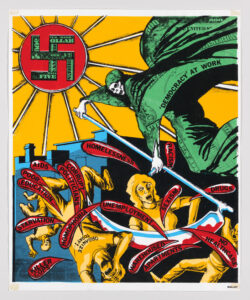
Democracy at Work by David Wojnarowicz, 1989, Screeprint, 23 × 18 7/8in. (58.4 × 47.9 cm), Whitney Museum of American Art, New York.
Shortly after the positive AIDS diagnosis of his partner, Tom Rauffenbart, in 1987, David Wojnarowicz also tested positive for AIDS. While his ideas around the epidemic were already staunchly defined by the loss of his own close friends, his thoughts became further radicalized by his own diagnosis. After the death of his close friend, Peter Hujar, Wojnarowicz inherited the apartment where Hujar lived and also inherited the various art supplies that Hujar had left in his death. Using these new materials, Wojnarowicz began to create vivid, poster-like images that drew on the visual language of protest graphics and political cartoons to critique American democracy during the late twentieth century. A towering, skeletal figure cloaked in dollar bills looms above the scene, wielding a baton labeled “Democracy at Work,” suggesting the violent enforcement of economic power. It also seems to poke at the fact that the Reagan presidency was far more focused on the economic growth of the United States, while seemingly casting the gay community as disposable and invaluable; the economy was a crisis, but not AIDS. Below, fragmented bodies are crushed beneath banners naming systemic crises that plagued urban life like AIDS, homelessness, racism, sexism, unemployment, drugs and lack of healthcare, terms that echo public debates of the 1980s and 1990s. The radiant sun formed from U.S. currency reinforces the dominance of money over civic ideals. Using bold colors, simplified forms, and accusatory text, the work reflects activist art responding to neoliberal policy, state neglect and the disproportionate suffering of marginalized communities under the promise of American democracy

This entry is licensed under a Creative Commons Attribution-NonCommercial-ShareAlike 4.0 International license.

