David Wojnarowicz was a prominent American multimedia artist and writer who is most often identified with his fierce activism during the AIDS crisis. Wojnarowicz originally gained particular visibility in the New York City art scene of the 1980s, a period marked by political conservatism, cultural backlash and the devastating impact of HIV/AIDS on queer communities. Wojnarowicz’s art was frequently labeled provocative by the mainstream media, not only because it addressed his gay identity and sexuality openly, but because it refused silence in the face of institutional neglect and censorship. While his activism is central to understanding his legacy, this exhibition aims to explore Wojnarowicz’s work through a lens that surpasses traditional notions of protest art; it is key to understand his work as a complex visual language that merges personal experience with collective trauma.
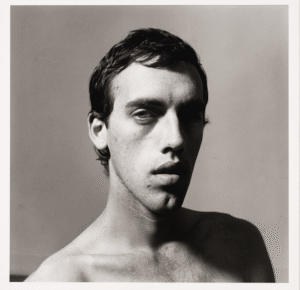
David Wojnarowicz by Peter Hujar, 1981, Gelatin silver print, 19 13/16 × 15 7/8in. (50.3 × 40.3 cm), Whitney Museum of American Art, New York.
At the core of this exhibition is the idea that Wojnarowicz used his own life experiences not as self-expression alone, but as a political tool. His work insists audiences understand that the personal is inseparable from the political, especially for those whose identities have been marginalized or erased by the political establishment of the United States. As a gay man who experienced homelessness, abuse, and later the AIDS epidemic firsthand, Wojnarowicz rejected the idea that art should remain detached from lived experience. Instead, he used his own body, his own stories as evidence, positioning himself and other gay men as both subjects and witnesses. This approach that Wojnarowicz takes in his art style challenges the traditional expectations of neutrality in art, asserting that detachment itself can function as a form of violence. In “Art Is Not Enough: The Artists Body as Protest”, Hannah Calkins makes the claim that “their bodies, their homosexual, HIV-infected, stigmatized bodies became the site of this tension between metaphor and action, art and protest, the personal and the political.” Wojnarowicz’s art has been interpreted as a form of “politicized embodiment,” where the artist’s body, and by extension, the bodies of those affected by AIDS, confronts the viewer with the realities of marginalization and loss. In this regard, his work resists any sort of distancing that normally would take place between the private body and public politics.
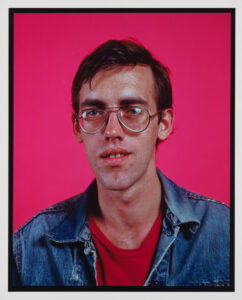
David by Neil Winokur, 1985, Silver dye bleach print, 19 15/16 × 15 15/16in. (50.6 × 40.5 cm), Whitney Museum of American Art.
One recurring motif throughout Wojnarowicz’s work is the body under threat. In many of his photographs and paintings, such as his piece titled Untitled (Hujar Dead) 1988-1989, bodies appear fragmented or overlaid with symbols such as maps, animals or religious imagery. These images reflect not only the physical toll of AIDS, but also the psychological effects of living in a society that treated queer lives as disposable. The image mentioned above does this in a striking and emotional manner as it portrays one of Wojnarowicz’s close friends, Peter Hujar, on his death bed. Hujar was diagnosed with AIDS in January of 1987 and tragically passed away 10 months later. The collage is made up of various images of Hujar’s feet and hands, as Wojnarowicz references how religious texts like the Bible believed them to be the holiest parts of the body. Over the photographs is a speech by Wojnarowicz that calls out the culture of homophobia that pours out of the American public, while also evoking rage and anger towards those who have let people like Peter Hujar die from AIDS solely because of their sexuality. This rage is best described by Hongting Pan in the Gender and Sexuality World History Journal, they write “Wojnarowicz’s visual politics of mourning made ‘memory a form of militancy.’ There was no passive grief in his work—only weaponized loss.” This idea of weaponizing loss is essential to understanding Wojnarowicz because by doing so, he made explicit the connection between policy decisions and bodily harm, refusing to let suffering remain abstract.
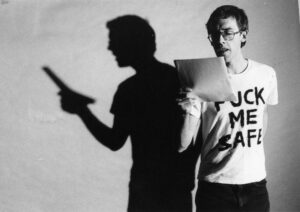
The David Wojnarowicz Foundation, 1990.
Text is another essential component of Wojnarowicz’s practice; it is impossible to view his writing as separate from his visual work. Whether scrawled directly onto images or presented as standalone texts, his words are confrontational and poetic. Wojnarowicz often wrote in the first person, addressing the viewer directly and implicating them in the structures of power he critiqued. This strategy collapses the distance between artwork and audience, forcing viewers to confront their own position within systems of privilege, indifference or complicity. In the context of a gallery space, his text disrupts passive viewing, transforming the exhibition into an encounter rather than an observation. His text was also literally disturbing, as oftentimes, Wojnarowicz would stand alongside his collages inside of art galleries and read the overlaid texts that specifically called out the United States government for failing his community. Wojnarowicz demanded that audiences not just saw his work, but heard it in its direct tone and message.
Landscape also plays a crucial role in Wojnarowicz’s visual language, and this exhibition emphasizes how he reimagined landscape as a political space rather than a neutral backdrop. Deserts, coastlines, highways, and city streets appear repeatedly in his work, often rendered as desolate or hostile environments. This is primarily seen in his photography, specifically his series titled Arthur Rimbaud in New York (1978-1979). In these photos, Wojnarowicz is depicted in various places over New York City with a life sized cut out of the French poet, Arthur Rimbaud, over his face. Wojnarowicz chose Rimbaud’s face for this series because he was inspired by his rebellious spirit and unconventional approach to his work. These landscapes mirror the emotional isolation experienced by many queer people who did not fit into societal norms and they function as sites of memory and survival. Unlike traditional landscape painting, which often celebrates ownership or national identity, Wojnarowicz’s landscapes in his photos are marked by impermanence, urban decay and displacement; they reflect a world in which safety is uncertain and belonging is constantly negotiated.
Censorship and institutional resistance are also central themes addressed in this exhibition. Wojnarowicz’s work was frequently targeted by conservative politicians and religious groups, most notably during the culture wars of the late 1980s. Attempts to defund exhibitions featuring his work reveal how threatening his art was to dominant narratives about morality and sexuality. By including documentation and references to these controversies, the exhibition situates Wojnarowicz within a broader struggle over who has the right to speak and be seen. His response to censorship was not retreat, but escalation; his later works are even more explicit in their anger and urgency. Scholarly work on the relationship between art and advocacy positions Wojnarowicz’s methodology alongside other activist artists whose work intentionally made public policy and institutional neglect visible through creative means.
Ultimately, this exhibition argues that David Wojnarowicz’s work offers a model for understanding art as an ethical and political act. Rather than separating aesthetics from activism, he worked tirelessly to bridge the gap between them, demonstrating how visual culture can bear witness to injustice while also creating space for mourning, rage, and solidarity. His work refuses closure or comfort, instead demanding sustained attention and accountability. In revisiting Wojnarowicz today, this exhibition aims to frame him not just solely as a historical figure of the AIDS crisis, but as an artist with autonomy, whose questions about power and survival remain as relevant today as they did 40 years ago.
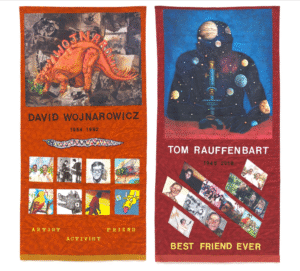
Two quilt panels honoring David Wojnarowicz and his partner Tom Rauffenbart for the AIDS Memorial Quilt

This entry is licensed under a Creative Commons Attribution-NonCommercial-ShareAlike 4.0 International license.

